




Imagine this: your grandmother leaves you her jewelry box filled with necklaces, earrings, and brooches, plus a few loose stones at the bottom. She never explained where they came from, so you may wonder if those stones are real diamonds.
Because diamonds are popular and valuable, many look-alike stones, such as cubic zirconia, exist to imitate them. The challenge is that you usually cannot tell a real diamond from a fake one just by looking at it. The good news is that there are several reliable ways to find out.

TABLE OF CONTENTS
- How to Tell if a Diamond Is Real
- How to Tell if a Diamond Is Real at Home
- VS1 vs VS2: How Prices Compare
How to Tell if a Diamond Is Real
You have two main ways to find out if a diamond is real or fake. First, you can take it to a professional who uses proper tools to test diamonds accurately. Second, if you prefer not to use an expert, you can try a few simple at-home tests to check whether your loose diamonds are real or not.How to Tell if a Diamond Is Real at Home
At-home tests cannot guarantee results, but they can be surprisingly reliable. You only need a few common household items to get started.The Sandpaper Test
This test is simple and quick. Take a piece of sandpaper and rub the rough side against the stone. Sandpaper ranks between 7 and 9 on the Mohs hardness scale, while diamonds are much harder. A real diamond will not scratch and will stay intact. A fake stone will show visible damage.The Read-Through Test
This test works best with loose diamonds that are not set in jewelry. Place a piece of paper with plain black text on a flat surface. Turn the diamond upside down and look through it at the text. You cannot read words through a real diamond. If the text looks clear or readable, the stone is likely fake.The Sparkle Test
How a stone reflects and bends light can reveal if it is real. Hold the stone under light and watch how it sparkles. Real diamonds reflect light in subtle gray and white tones. Fake or synthetic stones, such as cubic zirconia, show more rainbow-like flashes. If you see many bright colors, the stone is likely not a real diamond.
The Heat Test
This test requires care and works only on loose stones. Hold the gemstone with rubber-tipped tweezers and heat it with a lighter for 30 to 45 seconds. Then drop it straight into a container of cool water. Diamonds spread heat evenly and will not crack. Fake stones cannot handle the sudden temperature change and may break or shatter.
This test can damage fake stones, so only try it if you are willing to risk ruining them. If the stone stays intact, you can feel confident that it is real and strong enough to last a lifetime.
Real Diamonds vs. Lab-Created Diamonds
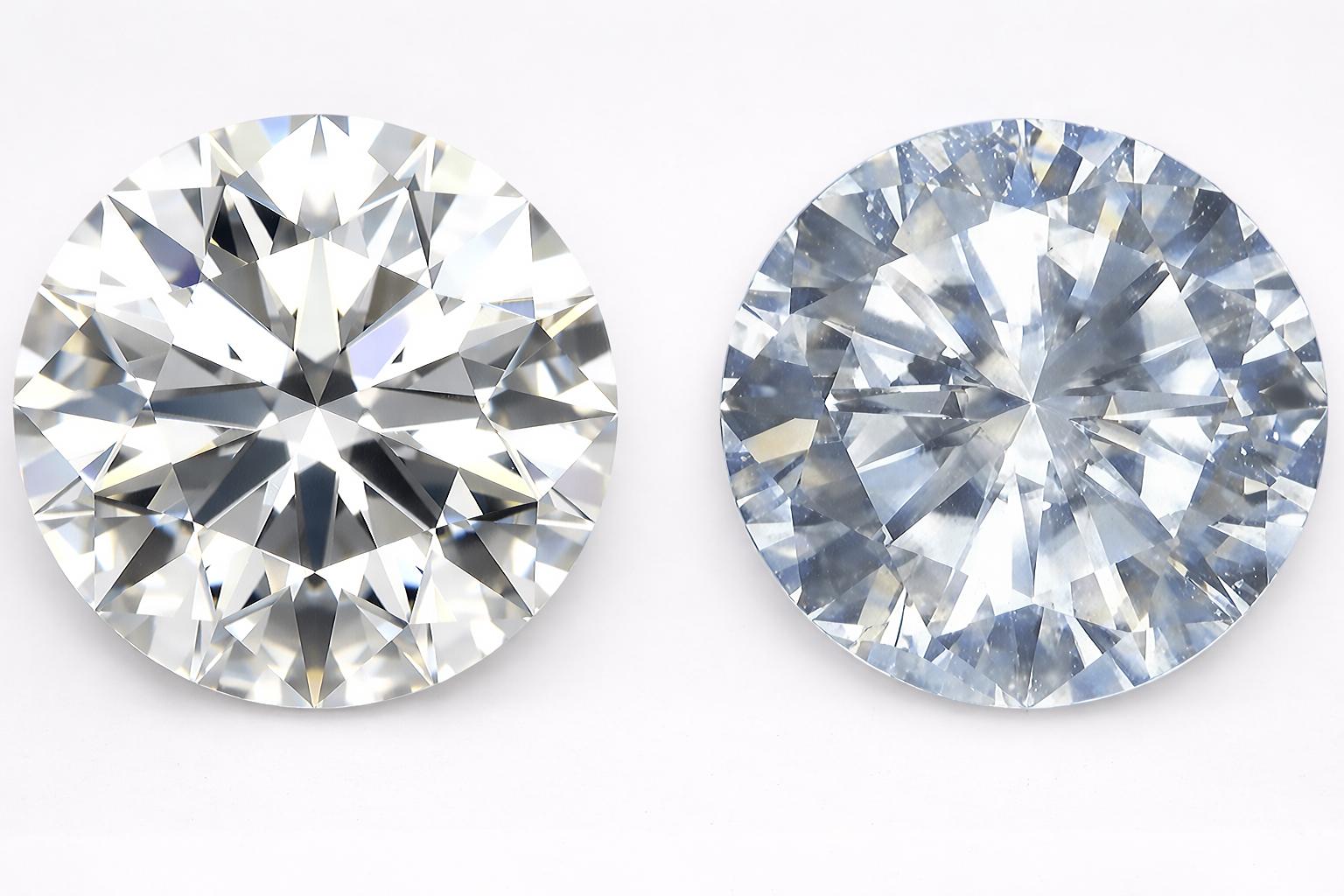
Lab-created diamonds are not fake. They are real diamonds made in a different way. Still, there are a few key differences to understand when comparing the two.
Natural diamonds form deep in the earth and are mined from the ground. Lab-created diamonds grow in controlled environments using Chemical Vapor Deposition (CVD) or High-Pressure High-Temperature (HPHT) methods. In these processes, carbon atoms build the diamond layer by layer inside a chamber. This usually takes a few months, though it can take longer.
Natural diamonds take thousands of years to form underground, while lab-created diamonds form much faster.
Diamonds vs. Moissanite
Moissanite is not a lab-grown diamond. Scientists first discovered it in the late 1800s inside a meteor. At first, it looked like diamond, but researchers later learned it is made of silicon carbide, not carbon like diamonds. Natural moissanite is very rare, so most moissanite stones today are lab-created. They look very similar to diamonds, but key differences exist. Color is one of the easiest ways to tell them apart. Diamonds show deeper, more stable color tones. Moissanite often flashes changing rainbow colors as it spreads light. Both stones can appear clear, yellow, or green, but stones with natural red, blue, brown, black, or purple tones are usually diamonds. Weight also sets them apart. Moissanite weighs less than a diamond of the same size and shape. This difference is hard to notice without professional tools unless you are very sensitive to small weight changes.How to Tell the Difference Between Diamonds and White Sapphires
White sapphires and diamonds can look very similar, which makes them hard to tell apart without expert tools. They often share the same size, color, and clarity, and both are very strong. In fact, only diamonds rank higher in hardness, and the difference is small. The real differences go beyond the surface. White sapphires form from corundum and grow in hexagonal crystal shapes. Diamonds form from carbon and grow in cubic crystal shapes. These structures affect how each stone is cut and how it reflects and bends light. Purity is another key difference. White sapphires are completely colorless, with no traces of other colors. Colored sapphires are separate stones. Diamonds, even very high-quality ones, often contain slight color tones or natural features. Truly colorless and flawless diamonds are rare.How to Check if a Mounted Diamond Is Real
A diamond set in a ring can give you clues about whether it is real or fake. Start by looking closely at the setting and the metal used. Real diamonds, whether natural or lab-created, have higher value and are usually set in quality metals. These include white gold, yellow gold, rose gold, or platinum. You will not usually find real diamonds set in cheap metals. Next, check inside the ring for metal stamps. Marks like 10KT, 14KT, or 18KT show the gold content. The letters PT or Plat indicate platinum. Numbers such as 585, 770, 900, or 950 can also point to gold or platinum. If you do not see these markings and instead find “C.Z.,” the stone is cubic zirconia, which is a fake diamond.How to Know if a Diamond Is Real: Ask a Professional
If you do not have time for at-home tests or want a reliable second opinion, take your stone to a qualified gemologist. This is the safest and most accurate way to confirm whether a diamond is real. Not all jewelers are gemologists. Many work in sales and do not have formal gemology training. When you visit a jewelry store, ask if a certified gemologist is available or if they can recommend a trusted local expert. A professional gemologist uses advanced tools and methods that go beyond simple home tests. They can identify real diamonds without risking damage to your stone, giving you clear and confident results.Diamond Testing With a Loupe
A loupe is a small magnifying tool used to inspect diamonds and gemstones. Gemologists use it to look for tiny flaws or marks inside the stone. Most real diamonds have small natural imperfections called inclusions. Fake diamonds usually look too perfect and lack these features.
The Diamond Tester Tool
Also called a thermal conductivity probe, this tool checks how a stone handles heat. Real diamonds spread heat very quickly after warming. Fake stones release heat more slowly, which makes them easy to identify.
High-Precision Weighing
Gemologists use highly sensitive scales to measure very small weight differences. They may also examine the stone under powerful microscopes or use X-ray testing. These methods help professionals confirm whether a diamond is real without guesswork.